According to data from Rosreestr, hacked by the Belarusian groups Belarusian Cyber Partisans and Silent Crow, at least 472,000 combatants on the Russian side have been killed in the war in Ukraine. Because death certificates are issued with a delay, the actual toll is estimated to have reached around 485,000 by the end of September and likely stands at almost exactly 500,000 as of today. Russian military fatalities peaked in the spring of 2025, when more than 61,000 people were killed in just three months. Over the course of the war, the average age of Russian servicemen has risen from 35.5 to 41. The Insider managed to identify most of the people on the list of those killed.
How we calculated the death toll
After the hacker groups Belarusian Cyber Partisans and Silent Crow published Rosstat's mortality data, questions arose about how to properly calculate military fatalities. Several international media outlets rushed to publish their findings and, in the process, undercounted the toll by approximately 50,000 people.
In our count, we include only deaths that are directly attributable to military operations occurring on or after February 24, 2022. They feature men and women of all ages whose records met at least one of the following criteria:
- the death was recorded as having occurred during military operations (code “6” in field 18 of the medical death certificate (Form 106/u); or
- any field specifying the cause of death contained the ICD-10 codes Y36 (“War operations”) or Y89.1 (“Sequelae of war operations”); or
- the textual description of the cause of death in any field contained the adjectives “military,” “combat,” “mine-related,” “thermobaric,” “charred,” “explosive,” “armed” or “shrapnel-related” (including all grammatical forms), or the nouns “fragment” or “projectile” (in any grammatical form); or
- the person was recorded as having served in the military, and the textual description of the cause of death in any field contained words derived from the roots “explosion,” “firearm” or “shot”; or
- the person was recorded as having served in the military, and their death certificate was issued by court order (code 17003 or 17005); or
- the person was recorded as having served in the military and was issued a certificate of death (code 17007), signed by the commander of their military unit; or
- a certificate of death (code 17007) was issued, and the cause of death was listed as undetermined (code “8” in field 18 of the medical death certificate); or
- the person was recorded as having served in the military, but the cause of death was undetermined; or
- the death certificate was issued by court order, and the death occurred in Ukraine or the place of death was not specified; or
- the person's citizenship was unknown, and their death certificate was issued by court order.
Rosstat's dataset omits the victims' names but retains other information, including their ages and dates of birth. The Insider has so far managed to identify more than 370,000 people by name. The searchable database is available here:
300 deaths a day and irrecoverable losses approaching one million
A closer look at Rosstat's data reveals a consistent lag between the date of death and its registration. Half of all deaths resulting from military operations in 2026 were registered within 37 days, while one in seven was recorded more than a year after it occurred. This means the actual death toll over the past year is almost certainly at least 10–15% higher than the figure reflected in Rosstat's records at the time of the hack, as information confirming an additional 8,000-16,000 deaths is likely to be registered in the coming months. This would bring total Russian losses to around 480,000-500,000, or an average of 280-300 deaths per day over the course of the full-scale war.
Rosstat may, however, have access to information not contained in the civil registry. According to the same cache of hacked correspondence, in June 2025 the military commissar of the Tomsk Region's Bakchar District requested data from Tomskstat on the number of births and deaths in 2024. Tomskstat reported 188 deaths that year, including 122 men. Yet by fall 2026, the civil registry recorded just 176 deaths in the district, with all 12 “missing” cases being men. In January 2026, the administration of Velikiye Luki asked Pskovstat for monthly birth and death figures for 2022–2024. The number of deaths missing from the civil registry for 2022–2023 totaled 124. For 2024, Pskovstat refused to provide the local authorities with any data, citing the Russian government's decision to suspend the release of such information.
The provision restricting access to such data was adopted by the State Duma on Feb. 22, 2023. It allows the government to regulate access to official statistics through decisions updating the Federal Statistical Work Plan, including by temporarily suspending the provision and publication of data. Previously, official statistics were publicly accessible, with exceptions limited to information protected by laws on banking, commercial, tax, medical confidentiality, and attorney-client privilege. The first such decision was a government order dated April 26, 2023, suspending the publication of oil and gas production figures. As the Esli Byt Tochnym (lit. "We're Being Precise") project previously reported, no separate order concerning demographic statistics could be found, and Rosstat itself declined to disclose its details.
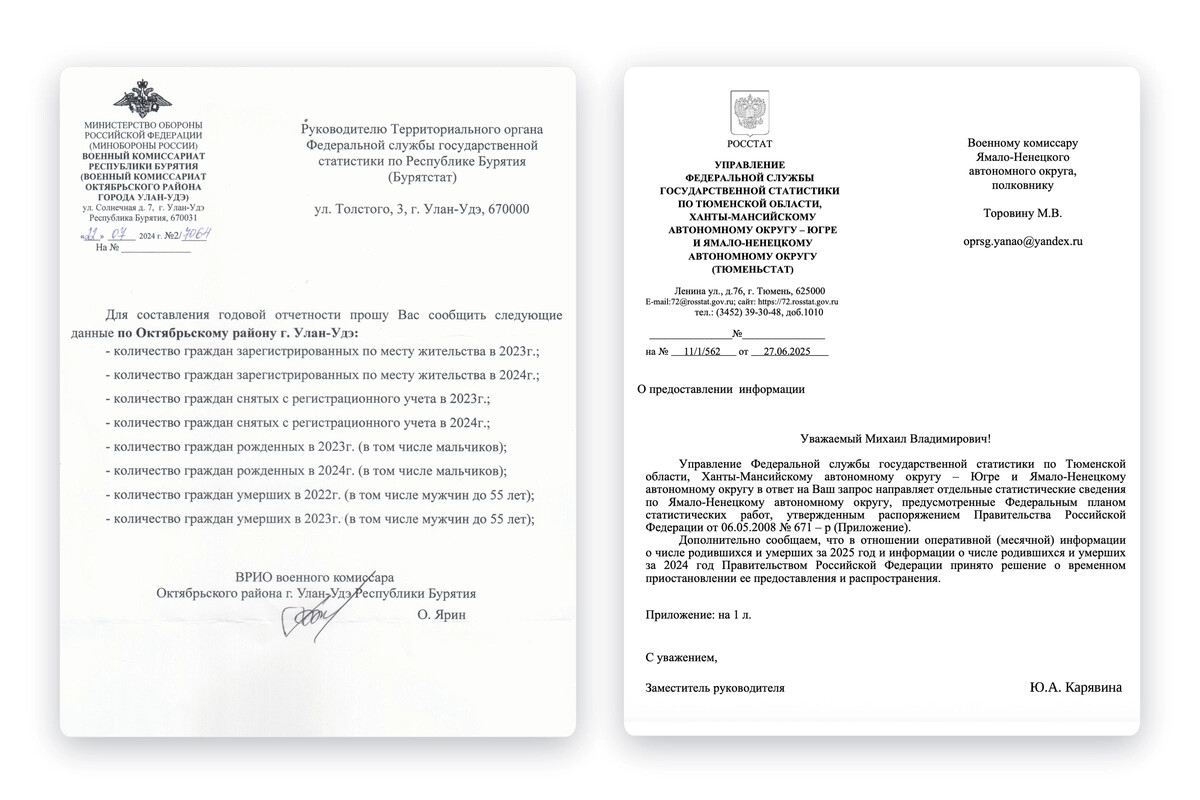
In its analysis of the available data, The Insider found discrepancies in several other localities that were similar to those observed in Tomsk (where regional statistics offices had responded to inquiries about birth and death figures). However, in some cases, statistical agencies refused to provide such information even to military enlistment offices.
Expert assessments have put Russian forces' ratio of killed to wounded at 1:1 since at least 2025, compared with the conventional ratio in modern warfare of 1:3 (one killed for every three wounded) or higher. Ukrainian data on Russian casualties for the period summer-fall 2026 suggest an even higher ratio: 1.4-1.5 Russian soldiers killed for every one wounded. This likely reflects the specific conditions on the battlefield, where evacuating wounded soldiers from the front line has become virtually impossible. Warfare in Ukraine is now characterized by the overwhelming dominance of drones, the near-total abandonment of armored vehicles, the use of infiltration tactics, and the expansion of the “gray zone” or “kill zone” to 30-40 kilometers from the front line.
Russia's total irrecoverable casualties may therefore already be approaching one million.
The deadliest battles
Until October 2023, spikes in Russian military fatalities were associated with specific, time-limited events: the withdrawal of Russian forces from the area around Kyiv in March–April 2022; their retreat from large swathes of the Kharkiv Region in September 2022 and from the city of Kherson and the right bank of the Dnipro River in fall 2022; and during the assault on Bakhmut in early 2023.
Ukraine's counteroffensive in the summer of 2023 failed to achieve its aims, and in October of that year, Russia launched a large-scale offensive of its own in the Donetsk region that gradually spread to neighboring areas of the Zaporizhzhia and Kharkiv regions. Pro-Ukrainian monitor DeepState and pro-Russian Creamy Caprice both identify the fall of 2024 and the first half of 2025 as periods of relatively rapid Russian territorial gains. Since then, however, their pace of advance has markedly slowed.
In 2025, Russia's average monthly death toll doubled, and the reasons are readily apparent. The slowdown in territorial gains coincided with an increase in the size of Russia's Joint Group of Forces and a sharp decline in the use of armored vehicles. Together, these trends reflect a shift in Russian military strategy toward infiltration tactics: instead of mechanized assaults, attacks are now conducted by small infantry groups advancing in loose formations through the ever-widening “kill zone,” where the ongoing proliferation and development of drones has made it far harder for unprotected infantry to survive.
The decline in recorded military fatalities shown on the chart from the summer of 2025 onward is evidently due to delays in Rosstat receiving up-to-date information. For example, the court procedure for officially declaring missing servicemen dead can take more than a year. There are also practical obstacles to recovering bodies from the battlefield amid the overwhelming dominance of drones.
Russia suffered its heaviest losses in the spring of 2025, when more than 61,000 soldiers were killed in just three months amid intense fighting along the Pokrovsk axis. In early April, a record number of clashes was recorded: more than 1,340, with over a third of them occurring near Pokrovsk. In addition heavy fighting continued around the Ukrainian-controlled area of Russia's Kursk region until April 29, when Russian Chief of the General Staff Valery Gerasimov announced that the area had been “completely liberated.” That spring, the Russian advances toward Kupiansk, Lyman, Chasiv Yar, Toretsk, and Pokrovsk also came at a heavy cost. According to the Institute for the Study of War (ISW), Russia gained 818 square kilometers in March and April while losing at least 38,000 lives, according to The Insider's estimates.
The Russian advances in the fall of 2024 also came at a heavy cost: fatalities exceeded 52,000 between November 2024 and January 2025 as Russia captured Kurakhove, occupied almost all of Toretsk, and encircled Velyka Novosilka. North Korean troops were also deployed to the front in the Kursk region.
No one knows how to count the war dead
In December 2025, Voronezh Region Governor Alexander Gusev wrote to the head of Rosstat, complaining that the current system for recording war deaths was distorting demographic statistics due to the fact that people killed in the war are often registered in the region where they died — for example, in occupied Ukrainian territory rather than in their home region in Russia.
One reason is a set of amendments adopted in 2023 to speed up the process of officially declaring participants in the war in Ukraine dead or missing. The rules were introduced to expedite compensation payments and other support for the families of fallen soldiers. Under the new procedure, death certificates can be issued not only by medical institutions but also by commanders of military units, who report the death to the civil registry office or a multifunctional public services center (MFC). Certificates confirming that a service member is missing must be issued within 30 days of a request from a family member, their legal representative, or a relevant government agency.
Gusev points out that because deaths are often registered in another region, a contradiction arises: the region where the person lived “bears the social and budgetary consequences of losing working-age residents, provides social support to the deceased's family, and accounts for the resulting demographic burden,” yet the person's death does not appear in its mortality statistics. The situation also creates problems for local authorities because population size is one of the target indicators used to assess governors' performance. Gusev asked the head of Rosstat to consider revising the methodology for compiling demographic statistics so that people killed in the war would be counted among the deaths in the regions where they lived, rather than the in the occupied territories where they died.
Notably, Gusev also calls for interagency data sharing “among all relevant authorities when identifying a deceased person's place of residence.” This effectively acknowledges that such information is often unavailable not only to civil registry offices and Rosstat, but also to the authorities in the region where the person lived. The Insider calculated that at least one in five Russians killed in the war in Ukraine did not even have their place of birth recorded.
Causes of death in the Russian-occupied territories
The Insider examined causes of death among residents of the occupied territories, excluding the war-related deaths discussed above. Data submitted to civil registry offices from the occupied parts of the Donetsk, Luhansk, Zaporizhzhia, and Kherson regions often contain significant gaps. Many fields on death certificates were left blank during the first 18 months of the full-scale invasion, including information on the cause of death itself. In 2025, medical causes such as heart attacks, strokes, and conditions associated with high blood pressure accounted for 60–66% of all deaths in the occupied territories — considerably higher than the Russian average from such causes, which accounted for 46% of all deaths in the country in 2023.
From early 2022 through September 2026, at least 111,000 people died from such causes in the occupied territories of Ukraine, according to Rosstat estimates (though the numbers will certainly be revised upward as new data comes in). More than half of these deaths were attributed to chronic ischemic heart disease.
Neoplasms, most of them malignant tumors, account for 10–14% of all deaths in the occupied territories, compared with the Russian average of 16%. The figures for diseases of the digestive system, including liver diseases, are similar: 5–6% in the occupied territories, against 6% across Russia. External causes of death, ranging from traffic accidents to homicides and suicides, are recorded less frequently in the occupied territories than in Russia as a whole: 5.5% versus 9%, excluding war-related deaths.