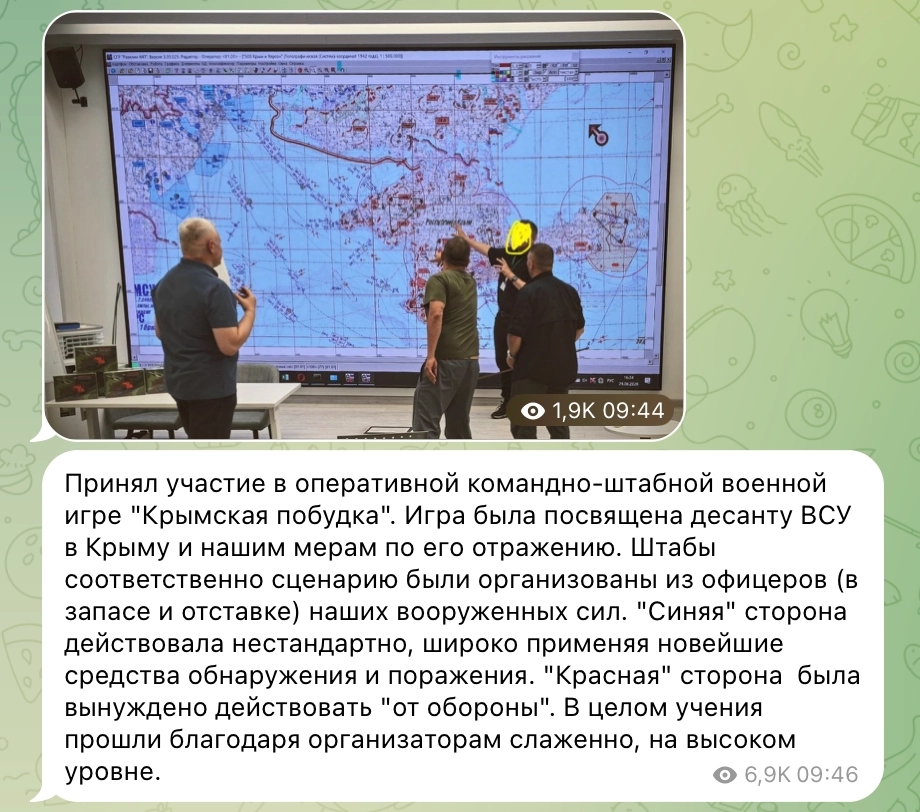
Russian military expert Viktor Murakhovsky said on July 2 that he had taken part in an operational command-and-staff exercise called “Crimean Wake-Up” («Крымская побудка»), devoted to repelling a possible Ukrainian landing in annexed Crimea.
Murakhovsky said participants in the exercise were gathered from reserve and retired officers of the Russian armed forces. The “blue” side, simulating the Armed Forces of Ukraine, “acted unconventionally” and made extensive use of the newest detection and strike systems. The “red” side, representing Russian forces, was forced to operate “from the defense,” he wrote.
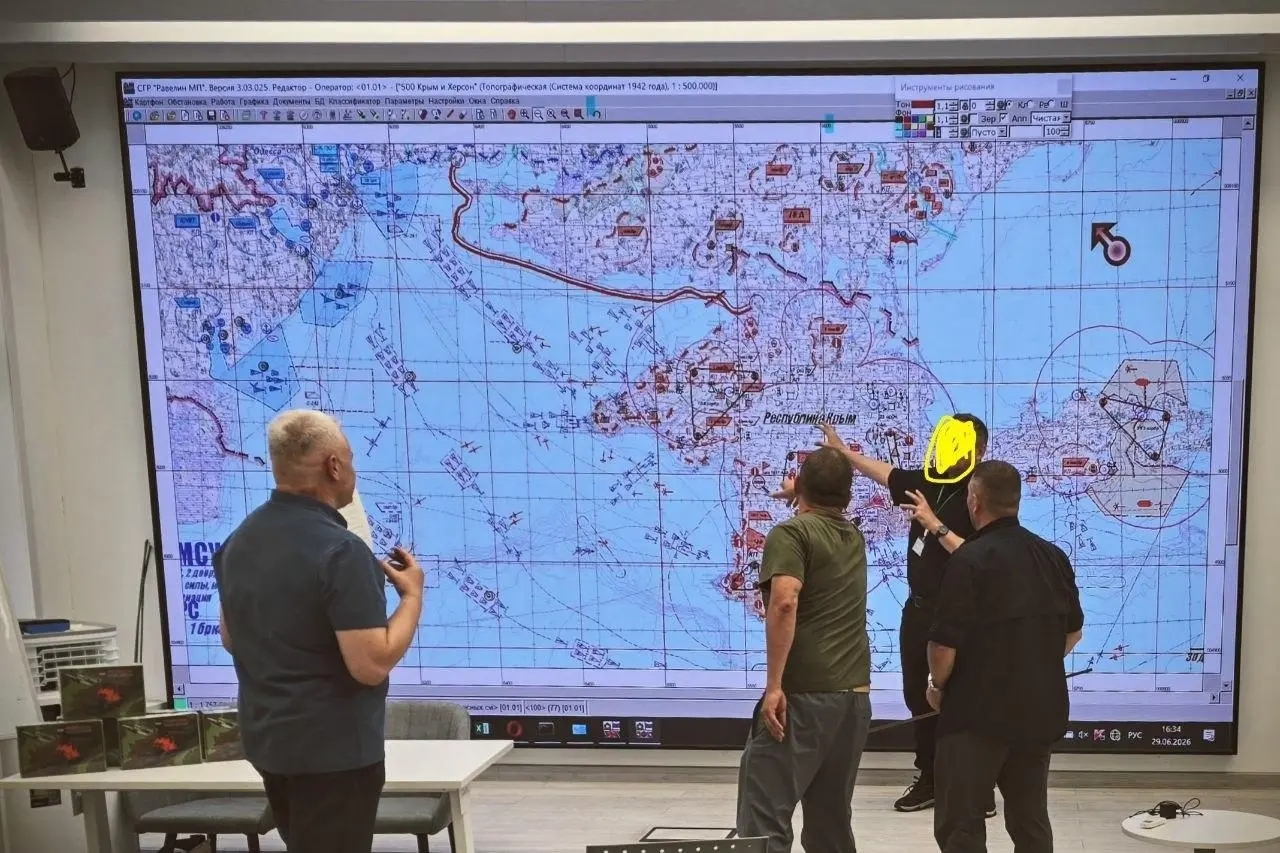
Murakhovsky’s post included a map of Crimea and the adjacent Black Sea area using the 1942 topographic coordinate system, known as SK-42. Almost all large-scale topographic maps of the former Soviet Union were made in SK-42. In other words, it is a standard topographic base map with layers. It appears to be used in SGR Ravelin, a specialized graphic editor and software module for Russian security agencies. The system is designed to create and edit the operational situation — color-coded vector information — overlaid on electronic terrain maps. The GIS program shows the label “[500 Crimea and Kherson],” likely referring to the base layer for SK-42.
The scenario clearly models an amphibious or naval operation. The Black Sea is marked with numerous blue arrows and routes running from the direction of Odesa and the northwestern Black Sea toward Crimea. Red defensive positions are visible in notable concentration around Sevastopol, northern Crimea, and the eastern part of the peninsula. The map also shows the area of Kerch and the Kerch Strait as being densely marked with “red” objects, meaning the exercise took into account not only western Crimea and Sevastopol, but also the eastern flank.
Judging by Murakhovsky’s post, the scenario likely did not involve a classic World War II-style landing, in which hundreds of ships approach the coast. Instead, it appears to have modeled a modern operation involving the mass use of drones, long-range precision weapons, reconnaissance systems, and possibly small high-speed boats.
Viktor Murakhovsky is a military expert, retired colonel, and former officer of the Russian General Staff. He is editor-in-chief of the magazine Arsenal Otechestva (lit. “Arsenal of the Fatherland”), a member of the expert council of the board of Russia’s Military-Industrial Commission, and an expert with the Izborsk Club, a nationalist and conservative Russian think tank. He has frequently appeared in Russian and foreign media as a military commentator. In his publications, he tends to be cautious and to avoid making concrete assessments.