Turkey is assembling a new “Sumud” flotilla for another attempt to break Israel’s blockade of the Gaza Strip. Participants in the pro-Palestinian effort accuse Israeli military personnel of abduction and even sexualized violence, and the behavior of Israeli National Security Miniser Itmar Ben-Gvir toward the flotilla’s participants has drawn criticism and condemnation within Israel itself. At the same time, activists acknowledge that the humanitarian cargo they have attempted to deliver is largely symbolic and that they have always understood the chances of successfully breaching the blockade are slim. Rather than preparing to work in a conflict zone, participants were carefully trained in how to handle media coverage of their own arrest and how to respond during interrogations. Critics accuse the activists of allowing radicals to exploit human rights defenders to advance their own political interests.
The latest attempt to breach the maritime blockade of the Gaza Strip was the seventh since the massacre of October 7, 2023. In total, since Israel imposed the blockade in 2009, activists of various backgrounds have tried to break it at least ten times. In more than half of those cases, the effort involved flotillas of four or more vessels.
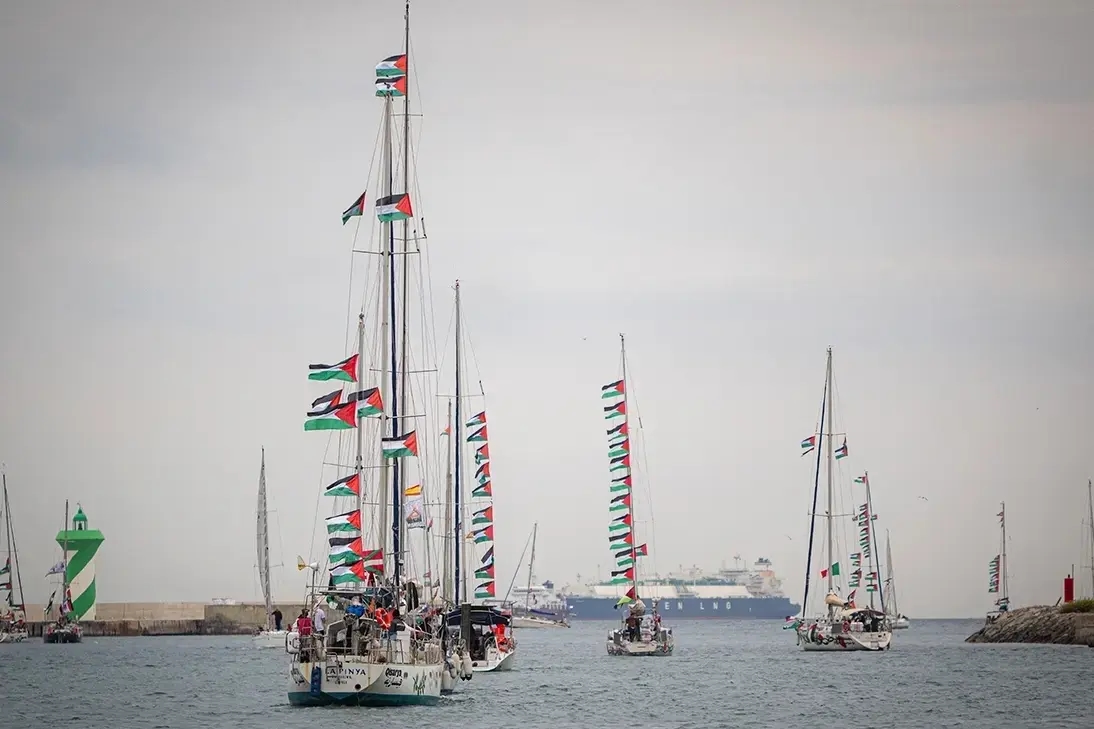
The movement to break the blockade took on a new character last year with the creation of the global “Sumud” flotilla. Between August and October 2025, as many as 50 small vessels took part in its voyages, and by May of 2026 that number had grown to around 60.
The Arabic word “Sumud” is most commonly translated as “steadfastness.” Since the 1960s, Palestinians have used the term to describe resistance to Israel. But the participants in the recent flotillas are far from exclusively Arab. On the contrary, the majority are left-wing activists from Western countries.
The latest expedition also included two participants from Ukraine: Andriy Movchan and Nina Potarska. Movchan, who also holds Spanish citizenship, has lived in Barcelona for the past 12 years, works in IT, and is involved in the local left-wing movement. It is from Barcelona that the “Sumud” yachts set sail.
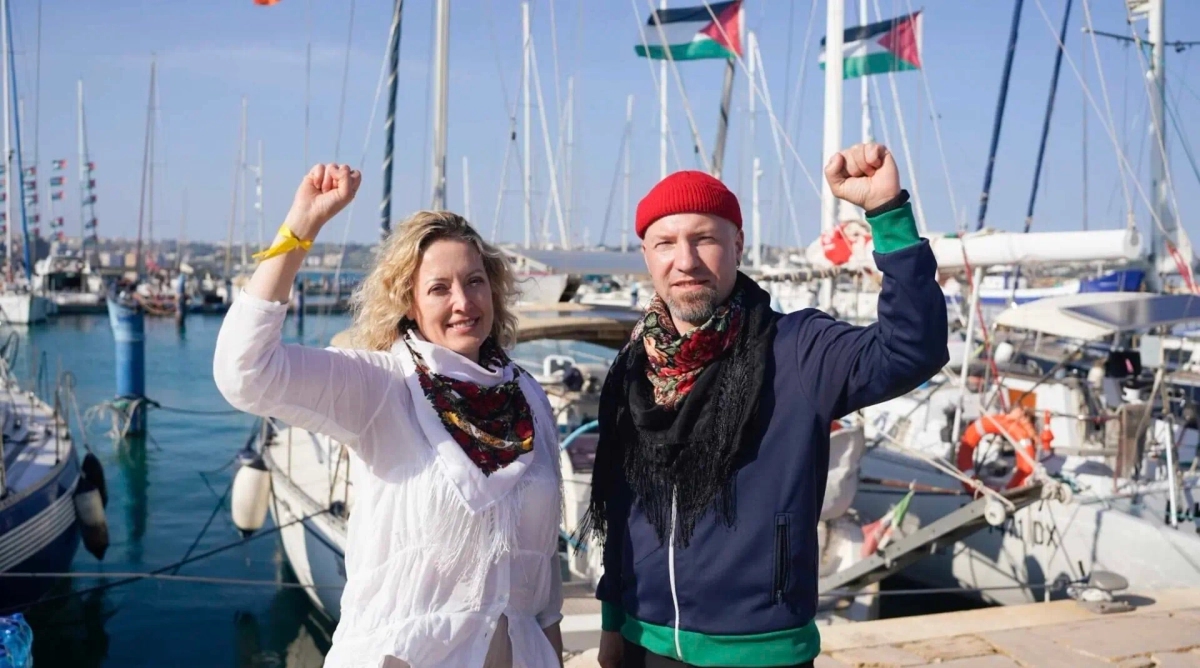
Movchan’s interest began in 2025, when he watched another flotilla depart and decided that next time he would try to join it. “There was a selection process. In Spain alone, there were nearly a thousand applications,” he told The Insider. “They tried to recruit people with captain’s licenses and maritime experience. They specifically looked for medical professionals who could help during the voyage and provide assistance to victims upon arrival. They recruited teachers to work with children and engineers to help rebuild Gaza. But most of the participants are activists, public figures, and opinion leaders.”
The organizers of the Gaza voyage declared that their goal was not only to deliver humanitarian aid but also to “create a sustainable civilian presence.” As the declaration states: “Teams of doctors, nurses, ecological builders, war-crimes investigators, unarmed civilian protection personnel, and other specialists will come ashore to work alongside the Palestinian people.”
Movchan believes he was chosen because of his active involvement in the Ukrainian pro-Palestinian movement. In the summer of 2025, when a number of international experts began sounding the alarm that a famine had begun in parts of the Gaza Strip (albeit by modifying the standard indicators the UN uses to make such determinations), Movchan decided to organize a pro-Palestinian demonstration outside the Holodomor Museum in Kyiv, even if he did not attend personally:
“Why am I not in Ukraine? I’m not the bravest person. After 12 years of living abroad, I have certain privileges of choice: whether to take part in the war or not.”
As for participation in the flotilla, activists are not required to make any financial contribution, and food and living arrangements are provided after they reach the port at their own expense. Nina Potarska, who lives and works in Canada, got to Spain thanks to the help of a fundraising campaign organized through the European Network of Solidarity with Ukraine. The left-wing organizations that make up the network support the Palestinian cause and were therefore happy to raise money for Potarska’s travel expenses, she explained.
“Eros,” also known as “Jabalia”
Movchan’s candidacy for the flotilla was approved at the last minute. He did not have time to complete all the training sessions, so instead of joining the others in Barcelona, he met them in Sicily.
“There was psychological and medical training. They explained what to do in the event of interception and imprisonment. We were taught about the history of Palestine,” he recalled. “There was also training on gender-based violence. By the way, all sexual relationships were prohibited on the yacht throughout the voyage, and I think that was the right decision. Finally, there was media training — about which issues to highlight and how to present them.”
The prohibition on sexual relationships was introduced for a reason. Shortly before departure, a sex scandal involving the previous flotilla erupted when one of the movement’s leaders, Brazilian activist Thiago Ávila, was accused of a series of unethical sexual encounters with female participants in the mission.
The yacht on which Movchan sailed was named Eros. However, all vessels in the flotilla were also given additional names honoring Palestinian localities. As a result, Eros was also known as Jabalia.
There were ten people on board: three with maritime experience, and the rest public activists. Among them were a Colombian woman campaigning for Indigenous rights, a Palestinian from Syria whose friends had fought against Assad, and an environmental activist from Australia. The yacht’s captain was responsible for maritime operations, while the activists’ activities were overseen by a representative of the organizers. Movchan says he is not authorized to disclose that person’s name.
The yacht also carried humanitarian aid, which occupied half of one cabin. It consisted of non-perishable food and medical supplies. “Naturally, it was more of a symbolic humanitarian aid shipment. You can’t fit much on a yacht,” The Insider’s interviewee acknowledges. “We didn’t purchase it ourselves; it was included in the flotilla’s budget.”
According to Movchan, neither he nor his fellow participants prepared extensively for work inside the Gaza Strip, as they “realistically understood” that the chances of breaching the blockade were close to zero. This contradicts the flotilla’s declaration but aligns with the actual training program. The emphasis was placed on preparing to interact with Israeli military personnel rather than with actual Gazans.
The activists did not prepare extensively for work inside the Gaza Strip because they “realistically understood” that the chances of breaching the blockade were close to zero
Movchan says he very much wanted to reach Gaza. Once there, he hoped to do journalistic work — speaking with local residents and covering the difficult conditions inside the enclave: “I was even thinking about how I would get out afterward. I understood that I only had four weeks of vacation and that if we actually made it to Gaza, I could lose my job. But I wasn’t afraid of that — not everyone gets an opportunity like this.”
Unexpected interception
The flotilla’s organizers expected Israeli forces to stop them somewhere between Cyprus and Gaza. Instead, Israeli troops boarded the yachts before they had even reached Crete. Movchan says that until the very last moment he thought the soldiers were Greek military personnel. He realized his mistake only when a weapon was pointed at him.
According to the activist, no one on the yacht was beaten during the detention. “At sea, they treated us more carefully so that nobody would fall overboard and there would be no casualties.” The detainees were gathered at the bow of the yacht, ordered to kneel, and subjected to searches. The cabins were searched, then the activists were then sent below one at a time to collect their belongings — everything they would need for a month in prison. Movchan was still not convinced he would be kept in custody for that long.
The detainees were transferred to an Israeli vessel, where they underwent questioning and further searches. No physical force was used against Movchan. However, he says that others were forced to move in a crouched position and were pushed around.
There was no physical violence, but detainees were forced to move in a crouched position and were pushed around
Nor does Movchan report any sexual harassment directed at himself or other members of the flotilla. However, after returning home, several activists claimed that they had experienced a total of 15 incidents of sexualized violence at the hands of Israeli personnel, while two female participants from Australia alleged that they had been raped. At the time of publication, no independent evidence or forensic examinations had been made public to substantiate those allegations. The Israeli side maintains that the accusations of sexualized violence “lack any factual basis.”
Movchan was among a group of more than 170 detained activists who were transferred to the custody of Greek authorities almost immediately. Two participants were held for about ten days before also being released. The Ukrainian activist says the experience was highly valuable: “Our goal was not only, or even primarily, to break the illegal blockade of the Gaza Strip. It was to break through a wall of stereotypes. In Ukraine, only the Israeli side of the story is presented.”
The right to impose a blockade
In the view of the “Sumud” flotilla participants, the blockade of Gaza is illegal. Israel, unsurprisingly, argues the opposite. The Israel Defense Forces press office summarizes the Israeli position as follows:
“The maritime area adjacent to Gaza is subject to a naval blockade imposed for security reasons in accordance with international law and is intended to prevent smuggling and terrorist activity that threaten the security of the State of Israel and its civilian population. The legality of the blockade and its enforcement under international law were also recognized by a special committee established by the United Nations for that purpose.”
A naval blockade is a formal concept in international law, defined as a method of warfare that may be employed during an armed conflict but that must nevertheless comply with a number of legal requirements. First and foremost, a blockade needs to be officially declared, as the Israeli action was all the way back on January 3, 2009.
For years, the legality of the Gaza blockade was questioned, primarily because the conflict is not between states but between Israel and Hamas, the terrorist organization that controls the enclave. Douglas Guilfoyle, a professor of international law at the University of New South Wales in Australia, notes that when the parties to a conflict are not states, a naval blockade can be established only if the conflict reaches a sufficiently high level of intensity.
The legality of the Gaza blockade was questioned for years because of the non-state nature of the conflict between Israel and Hamas
However, Wolf Heintschel von Heinegg, a maritime law expert and professor emeritus at the European University Viadrina in Frankfurt (Oder), Germany, counters that Israel’s position is supported by the 2024 advisory opinion of the International Court of Justice concerning “Israel's occupation of Palestine.” As von Heinegg explained in an interview with The Insider:
“Occupation is one of the subcategories of an international armed conflict, and Hamas acts as the representative of the Palestinian side. That removes the corresponding question regarding the legality of a naval blockade. However, for such measures to remain lawful, they must meet certain criteria. The most important of these is effectiveness. That means any vessel attempting to breach the blockade must be intercepted.”
This may sound unusual, but as the expert explains the rule originates in British practice dating back to the nineteenth century. At the time, Britain was fond of declaring naval blockades without actually enforcing them in practice. The implication is that if any vessels — even activists’ yachts — are able to cross the blockade line, the legality of the blockade itself could be called into question.
The second basic requirement of a naval blockade is non-discrimination, meaning that it must be applied equally to vessels of all countries. In 1994, a group of experts adopted the San Remo Manual on International Law Applicable to Armed Conflicts at Sea. Although the document does not have the force of an international treaty and is not universally applied, it states that a blockade must not be intended to starve the civilian population or otherwise use starvation as a method of warfare.
“Israel is not blockading Gaza in order to create famine but to restrict the flow of weapons and ammunition,” von Heinegg points out. “Another interpretation, derived from the Additional Protocol to the Geneva Conventions, concerns expected excessive harm and civilian deaths. In other words, the issue is not the existing situation but the harm that can reasonably be anticipated. And excessive deaths do not simply mean a large number of deaths — they mean a number that is disproportionate to the circumstances.”
In any case, such analysis has little bearing on the current situation in Gaza. Food and medical supplies continue to be delivered by land, and following the ceasefire, the humanitarian situation in the enclave did become less acute. The naval blockade does not affect those supply routes.
Whether there were weapons or other dangerous items on board is, from the standpoint of international law, largely irrelevant. As Douglas Guilfoyle explains:
“If the basis for stopping a vessel is that it is violating or attempting to violate a lawful blockade, the question is not whether it is carrying weapons. The question is whether it is knowingly attempting to enter or leave a blockaded area in defiance of the blockade. That is what distinguishes blockade law from the law of contraband.
The rules on contraband concern whether a neutral vessel is transporting weapons or other goods intended to support the enemy’s military effort and generally require at least reasonable grounds for suspicion. The rule governing blockades operates differently: it prohibits access to the blockaded coastline itself. Therefore, even a vessel carrying only civilians, food, or medical supplies may be regarded as violating the rule if the blockade itself is lawful.”
Since 2010, all flotillas have maintained that their purpose in attempting to break the blockade was to deliver humanitarian cargo to Gaza, but this does not mean that the blockading party is obliged to allow passage, von Heinegg notes. Nor does it mean that such cargo is exempt from inspection.
Guilfoyle adds that international law does not draw a clear formal distinction between a “humanitarian mission,” a “political protest,” and an “attempt to breach a blockade.” A single voyage may simultaneously be all three: carrying humanitarian aid, serving as a political demonstration, and constituting an attempt to break a blockade.
The legal assessment depends primarily on objective circumstances: whether a lawful blockade existed, whether it was properly declared, whether the vessel was aware of it, whether it attempted to cross the blockade line or enter the blockaded zone, and whether the enforcement measures taken were proportionate to the specific situation.
The legality of the detention
Much of the media coverage focused on the fact that the latest “Sumud” flotilla was intercepted far from its intended destination, and the blockade line itself lies a mere 20 nautical miles (37 km) from the Gaza coast. However, professor von Heinegg explains that the interception would have been unlawful only if it had occurred in another state's territorial waters — that is, within 12 nautical miles (22.2 km) of its coastline.
According to the expert, the activists made a major mistake by publicly declaring that their objective was to breach the blockade: “Once that intention had been announced, Israel acquired the legal right to intercept them on the high seas.” By contrast, he considers the actions of the Spanish government unlawful — specifically its 2025 attempt to provide naval escorts for the “Sumud” flotilla.
As for the methods used during the detention, this time there were no violent clashes. The situation was very different in 2010, when an attempt to break the Gaza naval blockade resulted in the deaths of ten people. In that case, the crew of the large vessel Mavi Marmara, which belonged to an NGO linked to Recep Tayyip Erdoğan and Turkish security structures, put up armed resistance, and the Israel Defense Forces opened fire.
Israel was widely accused at the time of using excessive force. However, von Heinegg disagrees: “To detain blockade violators, a boarding party must get aboard the vessel and take control of it. During the seizure of the Mavi Marmara, the crew actively resisted. They threw fire extinguishers and other objects at the Israeli soldiers. When the soldiers began descending from helicopters on ropes, they were attacked with steel rods. And being struck with iron bars constitutes an immediate threat to life. If a crew engages in hostile actions, it loses its immunity.”
What followed was a battle of reports. A Turkish investigation placed full responsibility for the incident on Israel, while the Israeli version declared the operation entirely lawful. The final report of the UN Secretary-General’s panel, chaired by Geoffrey Palmer, attempted to satisfy both sides. It upheld the legality of the interception but concluded that the killing of nine people was an excessive response.
Douglas Guilfoyle agrees with that conclusion: Israel had the right to use force, but the force employed was excessive. He notes: “In practice, particularly when civilian vessels and civilian passengers are involved, such an operation should resemble law-enforcement or policing actions more than conventional battlefield combat.”
Participants in the “Sumud” flotilla maintain that they were “illegally abducted” by Israeli security forces. The IDF, for its part, stated that they were “enforcing a lawful naval blockade using recognized and lawful means in accordance with international law.”
Once participants in a blockade-running attempt are detained, they fall under the jurisdiction of the blockading party. Since some flotilla activists are suspected of having links to Hamas, it is entirely legitimate to hold them for investigative purposes, von Heinegg explains. Other participants, however, were released and allowed to return home almost immediately. The same principle applies to detained vessels: a court must decide whether to release them along with their cargo or to confiscate them.
In May 2026, for example, a court in Haifa ruled that 11 vessels from the previous year’s flotilla should be confiscated. The decision was based on the traditional Prize Law of 1864, which, despite its age, remains in force.
To an ordinary observer, the confiscation of a privately owned vessel may seem unusual. Under the law of naval warfare, however, a ship that knowingly violates a lawful blockade has historically been treated not merely as private property but as an instrument used to breach a wartime measure recognized by international law. For that reason, states may not only detain such vessels but also, through a specialized prize court, transfer ownership of them to the state.
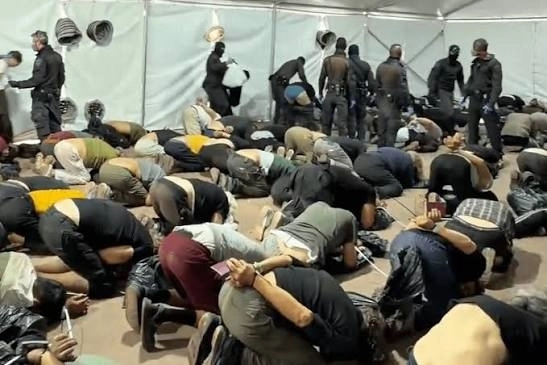
Nevertheless, von Heinegg considers the actions of Israeli National Security Minister Itamar Ben-Gvir, who mocked detained flotilla activists and recorded the incidents on video, to be unacceptable: “He humiliated people who were restrained, and that cannot in any way be regarded as humane treatment of detainees.”
Vincent Shebat, a former Israeli military intelligence officer and now an analyst with the nonprofit organization NGO Monitor, also considers Ben-Gvir’s behavior inappropriate. Shebat researches anti-Israel activities by international NGOs and their alleged links to terrorist organizations. He argues that the recent attempts to breach the Gaza blockade differ significantly from similar efforts 15 years ago, both tactically and when it comes to the composition of participants:
“The people aboard the Mavi Marmara were far more aggressive. The context has now changed. There is much more discussion of human rights and humanitarian aid, and the language of human rights advocacy is being used. Participants include members of the European Parliament and NGO activists — not only groups linked to Hamas operating under the guise of NGOs, but also genuine humanitarian organizations. Most of the people on these boats are what some would call ‘useful idiots.’ They are investing their efforts in a public-relations campaign organized by Hamas to portray Israel as inhumane.”
And if the objective really was to generate negative PR about Israel, Shebat adds, then Itamar Ben-Gvir’s actions helped make the activists’ operation a success.
Is the flotilla tied to Hamas?
Some activists and organizations involved in the “Sumud” movement are indeed under sanctions over their alleged links to Hamas and the Muslim Brotherhood. The central figure among them is Saif Abukeshek, a Palestinian activist who holds Spanish citizenship.
Israel says that Abukeshek’s ties to Hamas have been proven based on documents obtained in Gaza. According to the Israeli government’s account, Abukeshek directly controls dozens of vessels in the flotilla through a front company called Cyber Neptune, which appears in Spanish corporate registries listing Saif Abukeshek as its sole manager. He denies, however, that he owns the vessels participating in the flotilla.
Since May 2026, Abukeshek has been subject to U.S. sanctions for supporting Hamas as a member of the General Secretariat of the Popular Conference for Palestinians Abroad (PCPA). The movement itself was added to U.S. sanctions lists in January of this year. “The strategic and tactical aspects of PCPA’s activities are controlled by Hamas through the appointment of key Hamas-affiliated figures to leadership positions within the organization,” the U.S. Treasury states.
Earlier this year, sanctions were also imposed on Zaher Khaled Hassan Birawi, a British pro-Palestinian activist who helped found of the PCPA and works as an organizer of blockade-running flotillas. Birawi was photographed at events with former Hamas Political Bureau chief Ismail Haniyeh, who was killed in an Israeli strike on his residence in Tehran in July 2024. Birawi participated not only in the “Sumud” campaign but also in the Mavi Marmara’s 2010 attempt to breach the blockade.
Birawi plays a central role in the current campaign, according to another Israeli NGO, the Meir Amit Intelligence and Terrorism Information Center. The organization’s researchers collect information from open sources and have compiled an extensive dossier on the “Sumud” movement. Representatives of the organization told The Insider that Israel, based on its own intelligence, identified Birawi as a Hamas member as early as 2010. The institute believes that U.S. authorities possess independent evidence linking him to the organization.
Finally, some flotilla leaders openly express their support for Hamas and the Lebanese group Hezbollah. One example is Thiago Ávila (he of the recent sex scandal). In November 2025, Ávila traveled to Beirut to attend the funeral of Hezbollah leader Hassan Nasrallah, describing him as “one of the greatest figures in the region and in the history of the struggle against imperialism.”
Another flotilla leader, Muhammad Nader al-Nouri, has been photographed with Hamas Political Bureau member Ghazi Hamad. In an image from the same collection, two other members of the flotilla’s steering committee, Marouane Ben Ghattaya and Wael Naouar, are shown posing for a group photograph with Hamas representative Yousef Hamdan in Algeria. Also visible in the picture is Ihsan Ataya, a representative of Gaza’s other terrorist organization, Palestinian Islamic Jihad.
Of course, U.S. sanctions do not carry decisive weight in European judicial systems. On May 27, a court in Rotterdam acquitted Amin Abu Rashed, one of the flotilla’s organizers in the Netherlands, on some of the charges against him. Prosecutors had sought a four-year prison sentence, alleging that he had raised millions in donations for Hamas.
The court found insufficient evidence that the funds raised by Abu Rashed had been directed to Hamas in Gaza. The judges also decided to “exercise caution” regarding the testimony of the prosecution’s principal expert witness due to the fact that his conclusions relied heavily on Israeli and U.S. reports.
In addition, the Rotterdam court noted that Abu Rashed’s main organization, the Israa Foundation, is not subject to European sanctions, even though the United States imposed sanctions on both the foundation and Abu Rashed himself a year earlier over their alleged ties to Hamas.
In the end, the Palestinian activist was convicted only of sanctions evasion and cooperation with the banned Al Aqsa Foundation. Abu Rashed received a short suspended sentence.
Why not simply let them through?
No one claims that the “Sumud” movement consists entirely of Hamas supporters. It also includes activists from nonprofit organizations, and the flotilla vessels did in fact carry humanitarian aid, even if only in symbolic quantities.
In theory, after inspection and screening, the cargo could have been allowed through the blockade, says maritime law expert von Heinegg:
“If some of the yachts had been permitted by Israel to deliver humanitarian aid to the Gaza Strip, that would not have been considered a breach of the blockade and would not have led to the blockade being deemed ineffective.”
The IDF press office did not answer The Insider’s question as to why Israel did not opt to inspect flotilla participants and humanitarian supplies and allow genuine humanitarian support to then enter Gaza.
Vincent Shebat believes there are two main reasons. First, “if you allow one boat through, next time there will be a thousand.” Second, the Israeli side does not want to “assume responsibility for activists and journalists if something happens to them inside the Gaza Strip.”
The Israeli side does not want to assume responsibility for activists and journalists if something happens to them inside the Gaza Strip
Those concerns are not unfounded. In 2008, at a time when Israel had already begun restricting access to Gaza but had not yet formally declared a blockade, two boats carrying European activists managed to reach the port of Gaza. Among them was Italian activist-journalist Vittorio Arrigoni, the son of the mayor of a small town on Lake Como.
In Gaza, Arrigoni engaged in activist journalism — largely the same kind of work that Ukrainian activist Andriy Movchan had hoped to undertake. But in 2011, Arrigoni was kidnapped by militants from an Islamist group unaffiliated with Hamas. He was tortured and killed.
At the same time, humanitarian aid can be delivered to Gaza without putting anyone’s life at risk. Israeli authorities offered participants in the recent flotillas the opportunity to hand over food and medical supplies in the port of Ashkelon and guaranteed that the cargo would be delivered to its intended recipients. The activists formally declined.
At the same time the maritime expedition was underway, other members of the “Sumud” movement attempted to reach Gaza by land. They were intercepted in Libya, surrounded, and subjected to violence. The local authorities stated that they would transfer the humanitarian aid through the Red Crescent. Activists who refused that arrangement were detained.
But the story is not over. According to project leader Behesti Ismail Songur, the next mission is expected to take place in the coming months. There is little reason, however, to believe that its outcome will be significantly different from that of the previous attempts.